How an Angler Is Interviewed Matters
Why access-point and roving interviews need different treatment
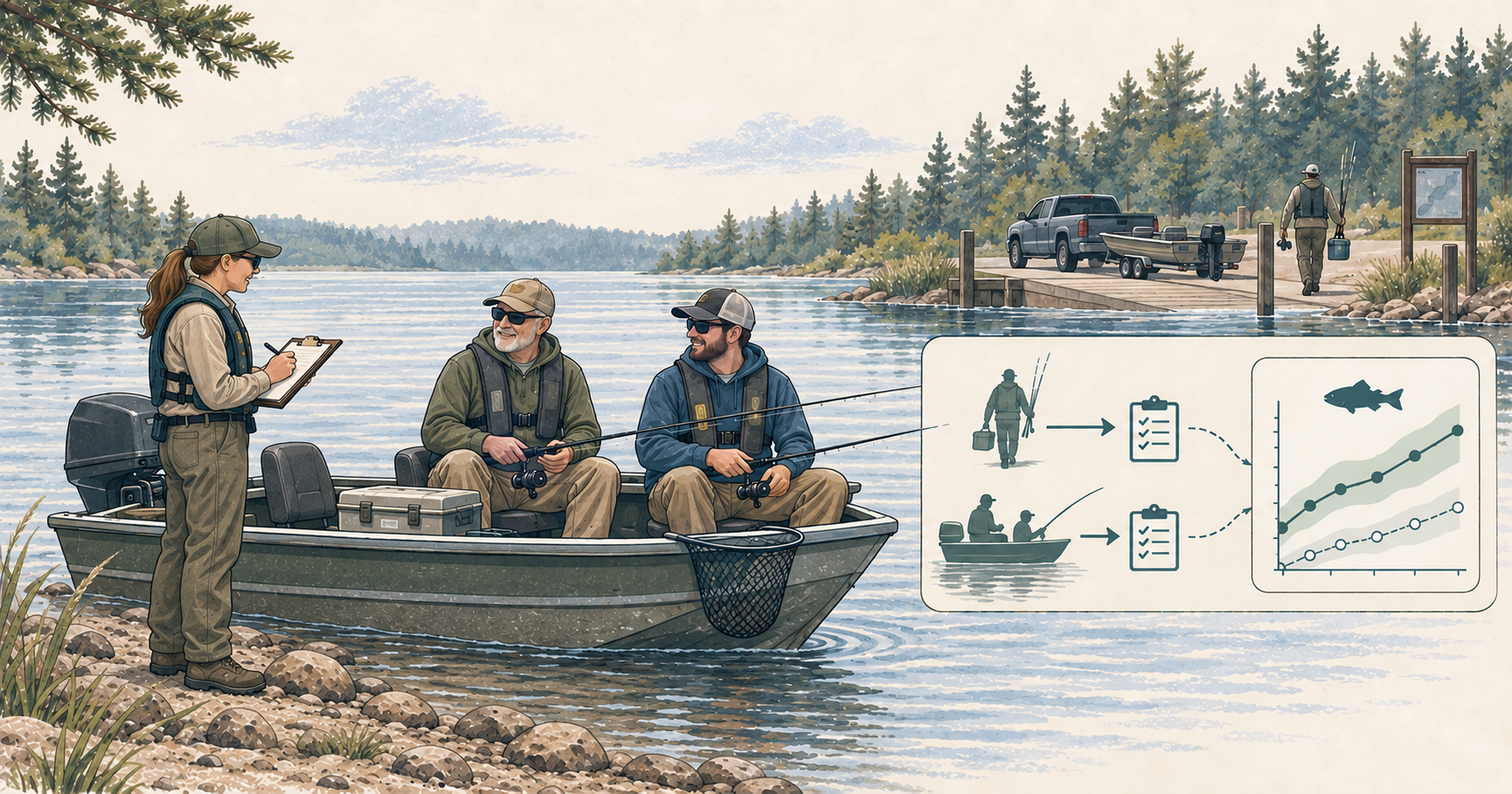
The sampling-calendar post was about the days a survey can represent. The next question is smaller, but just as important: how was an angler interviewed?
An access-point interview usually happens at the end of a trip. A roving interview happens while the angler is still fishing. Both can record hours, catch, harvest, and the species an angler sought, but they are not interchangeable observations. How the interview was collected changes both what has been observed and an angler’s chance of being encountered.
In brief
- Access-point interviews generally describe completed trips and support a ratio-of-means rate estimator.
- Roving interviews intercept anglers while they are fishing, and longer trips have more opportunity to be encountered. When the design is declared as roving,
tidycreeluses all eligible interviews with a mean-of-ratios estimator by default.- Declaring the interview type is part of specifying the survey design, not a label to add after an estimate has been calculated.
The same questionnaire can produce different observations
Imagine that a clerk interviews two anglers at a boat ramp. They have put their boat on the trailer and are heading home. Their reported hours fished and catch describe completed trips. An access-point interview is therefore a natural setting for estimating a rate from total catch divided by total effort across those trips.
Now imagine a clerk moving through the fishery by boat. The clerk speaks with an angler who launched at dawn and plans to fish until noon. At 9:30, the angler’s reported catch and effort describe only the trip up to the time of the interview. The angler may accumulate more effort, catch more fish, or harvest additional fish before going home.
There is another important difference. An angler fishing for six hours is available to a roving clerk for longer than an angler fishing for one hour. Longer trips therefore have more opportunity to be intercepted.
That is not a flaw in roving surveys. It is part of their sampling process. The estimator needs to reflect how anglers entered the interview sample rather than treating a roving interview as though it were simply an unfinished access-point interview.
What the survey literature adds
This distinction comes from the creel-survey literature, not from a software convention. Pollock, Jones, and Brown (1994) set out access-point and roving interviews as different ways of contacting anglers within a broader survey design. The practical point is the one that matters here: an access interview normally observes a completed trip, whereas a roving interview observes the part of a trip visible at the time of contact.
Pollock et al. (1997) make the sampling consequence explicit. In their formulation, anglers are intercepted with equal probability at access points, but an angler’s chance of being encountered in a roving survey is proportional to the completed-trip length. They therefore recommend ratio-of-means for access interviews and a mean of individual catch-to-effort ratios for roving interviews.
Hoenig et al. (1997) develop the roving catch-rate and total-catch estimators in more detail. Under their modelling assumptions, very short observed trips can make an untruncated mean-of-ratios estimate unstable. Their simulation results support dropping interviews observed within the first 30 minutes of a trip before calculating that estimator.
These sources do not prescribe one estimator for every creel survey. They show why the estimator must follow the interview and sampling design. That is the connection tidycreel is trying to preserve when the analysis records interview_type, trip status, and observed duration.
Start by recording how the interview was collected
In tidycreel, add_interviews() records the interview type along with catch, effort, trip status, and, when available, trip-duration information. This is one place where a small declaration prevents a much larger ambiguity later in the workflow.
library(tidycreel)

data(example_calendar)
data(example_interviews)

roving_design <- creel_design(
  example_calendar,
  date = date,
  strata = day_type
) |>
  add_interviews(
    example_interviews,
    catch = catch_total,
    effort = hours_fished,
    trip_status = trip_status,
    trip_duration = trip_duration,
    interview_type = "roving"
  )
The calendar establishes the days and strata that organize the analysis. The interview type answers a different question: how did an angler become available for an interview?
Both pieces of information belong in the design object before we estimate a catch or harvest rate.
An access-point design is declared in the same place with interview_type = "access". That is currently the default, but I prefer to state it explicitly in a project script. Doing so leaves the field protocol visible to the next person who reads the analysis.
What the roving declaration changes
For an access-point design, estimate_catch_rate() defaults to completed-trip interviews and a ratio-of-means estimator. The ratio-of-means pools the interviews first: total catch across the sampled trips is divided by total effort across those trips.
That aligns the rate estimator with the completed-trip observations collected at the access point.
For a roving design, tidycreel recognizes a different sampling process. When neither use_trips nor estimator is specified, it uses all eligible complete and incomplete interviews with a mean-of-ratios estimator. Rather than pooling catch and effort first, the mean-of-ratios calculates a catch-per-unit-effort rate for each eligible interview and then averages those individual rates.
The same design-aware choice carries through the catch, harvest, and release-rate workflows and the totals constructed from those rates.
# Roving design: all eligible interviews + mean-of-ratios
roving_cpue <- estimate_catch_rate(roving_design)

# Override the defaults when completed trips are specifically wanted
complete_trip_cpue <- estimate_catch_rate(
  roving_design,
  use_trips = "complete",
  estimator = "ratio-of-means"
)
These calls do not simply calculate the same quantity in two different ways. They use different subsets of the interview sample and different estimators.
The second can be useful as a diagnostic comparison, or when the scientific question specifically calls for completed trips. It should not quietly replace the roving estimator simply because completed trips are more familiar.
Why this matters for creel-survey estimates
Interview type affects more than the label on a CPUE result. In a conventional creel survey, estimated total catch or harvest is often calculated as estimated total effort multiplied by an estimated rate. The rate must therefore be on the right footing before it is expanded to a day, season, fishery, or management unit (Pollock et al. 1997).
That has several practical implications:
- A mismatch between the interview protocol and estimator can carry into total catch, harvest, and release estimates, rather than remaining a technical difference in a table of CPUE results.
- Rates from years, locations, or survey programs are only directly comparable when the way anglers entered the sample and the estimator used to analyze them are comparable too.
- The field record needs to retain interview type, trip status, and observed duration. Without them, an analyst cannot show which interviews contributed to an estimate or reproduce the decision later.
Choosing the roving estimator addresses the unequal opportunity for longer trips to be encountered. It does not remove every challenge of a roving design. For example, when an effective bag limit changes angler behavior or catch rates over the course of a trip, an interview during the trip may no longer represent the completed trip in the same way. Pollock et al. (1997) show that this can produce biased roving estimates, so those fisheries warrant a design review rather than an automatic estimator choice.
Very short trips need special attention
The default roving path also applies a 30-minute minimum trip duration for mean-of-ratios estimation, following the short-trip treatment discussed by Hoenig et al. (1997).
The reason follows from how the estimator works. Each interview contributes its own catch-per-unit-effort rate. When very little effort has been observed, even a single early catch can produce an extremely large individual rate. An angler who catches a fish shortly after beginning a trip, for example, can have a very high observed catch-per-hour rate even though little of the trip has actually been observed.
Those extreme individual rates can make the estimate unstable.
By default, tidycreel therefore excludes interviews with observed trip durations shorter than 0.5 hours before calculating the mean-of-ratios estimate. The threshold is part of the estimator and should be reported as such. It is not a general data-cleaning rule saying that short fishing trips are invalid observations.
Complete and incomplete are not a data-quality ranking
It is tempting to read an unfinished trip as incomplete data. In the ordinary-language sense, the trip is incomplete. In a roving survey, however, that does not mean the interview is a mistake, a deficient record, or an access-point interview that happened too early.
The angler was encountered during the trip by design.
The useful question is therefore not whether the trip was complete. It is whether the observation contains the information required by the estimator appropriate to the survey design.
This distinction is also why trip_status and trip-duration information should be retained during data preparation. They document what the clerk actually observed, support the appropriate estimation path, and make it possible to review later exactly how the rate was calculated.
A short checklist before estimating rates
Before estimating CPUE, HPUE, or release rate, I would stop and ask:
- Did interviews occur after anglers completed their trips, or while anglers were still fishing?
- Does the interview table retain valid complete/incomplete trip status?
- For roving interviews, is the information needed to determine observed trip duration available?
- Does the estimator reported in the output match the interview design?
- If a minimum observed duration was applied, is that threshold documented?
- Can someone reading the script tell why this estimator was used?
These are field-method questions as much as R questions. A well-organized table cannot reconstruct a sampling process that was never recorded. It can, however, keep that process visible throughout the analysis.
The tidycreel reference site documents the function-level arguments for add_interviews() and the rate estimators. The earlier posts on the design object and sampling calendar provide the larger context.
The calendar tells us when the fishery could be sampled. The interview protocol tells us how anglers entered the sample. The estimator determines how those observations become an estimate.
Those are parts of the same survey design, not separate decisions to reconcile at the end.
References
- Hoenig, J. M., C. M. Jones, K. H. Pollock, D. S. Robson, and D. L. Wade.
- Calculation of catch rate and total catch in roving surveys of anglers. Biometrics 53:306-317.
- Pollock, K. H., J. M. Hoenig, C. M. Jones, D. S. Robson, and C. J. Greene.
- Catch rate estimation for roving and access point surveys. North American Journal of Fisheries Management 17:11-19.
- Pollock, K. H., C. M. Jones, and T. L. Brown. 1994. Angler survey methods and their applications in fisheries management. American Fisheries Society Special Publication 25, Bethesda, Maryland.
The next post will turn to the linked tables that carry counts, interviews, catch, and biological data through the rest of a creel analysis.